28 April 2026
The newborn session in the first two weeks: how it actually goes
Why the fourteen-day window exists, what a baby-led session means, and what really happens across the three to four hours we spend together in the studio.
I am a photographer, but I am also a nurse and a mother. I can't separate those three things when there is a newborn in front of me, and I think that is exactly why my newborn sessions look the way they do: unhurried, without forced posing, with the baby leading from beginning to end.
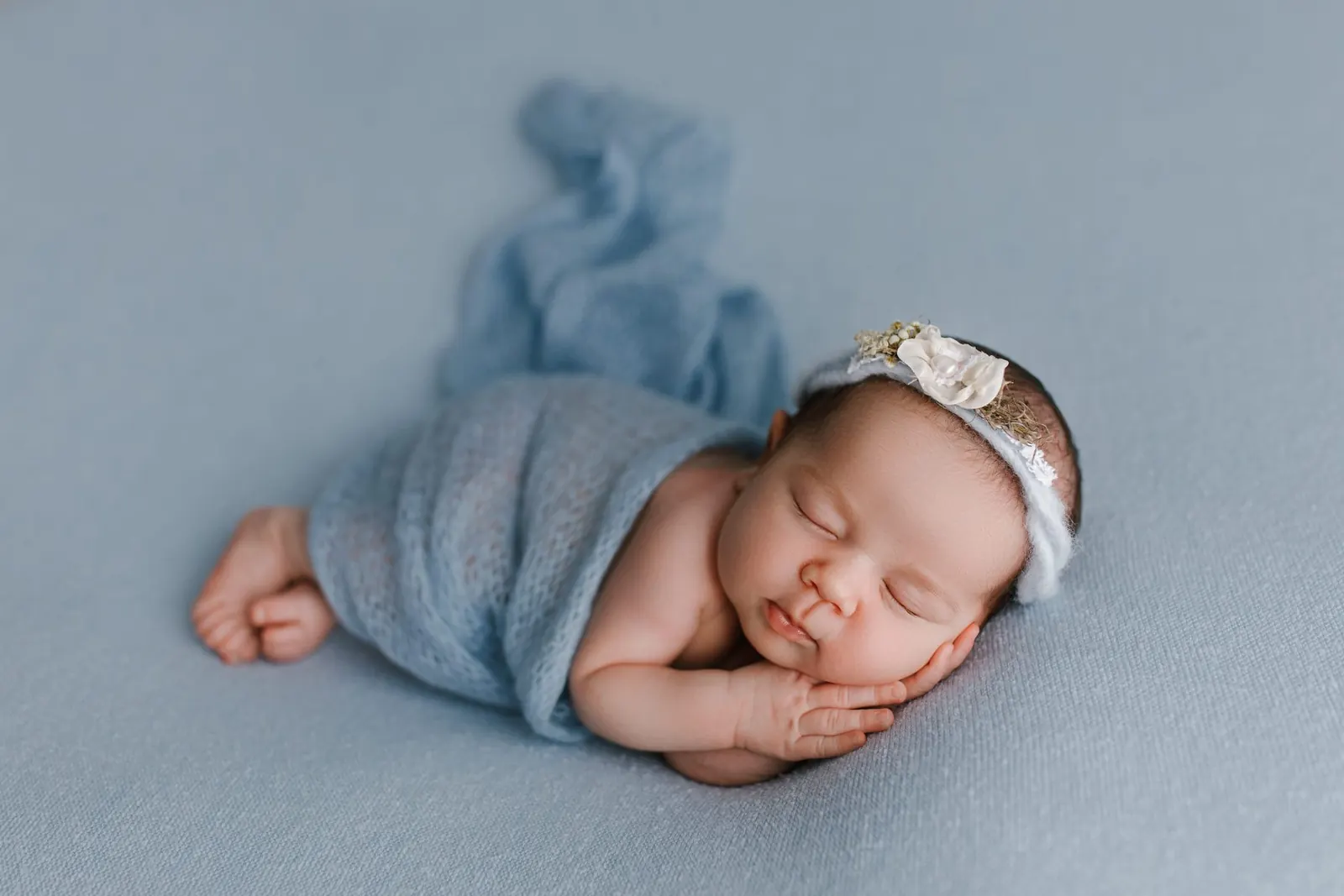
The first question is almost always about timing. Newborn sessions happen within the first fourteen days, and there is a practical reason for that. During those days a baby still sleeps deeply for much of the day, holds that curled posture from the womb and settles easily. From the third week onwards things change: they are more awake, they stretch out, colic arrives and sessions become far less predictable. They are still possible — the photographs are simply different.
That is why I ask families to book during pregnancy, usually around the seventh or eighth month. We don't fix an exact day. I hold a window, and once the baby arrives we agree on the actual date. That way the diary isn't full in precisely the week we need it.
The session lasts three to four hours, and that is the number that surprises parents most. It isn't four hours of photographing. It is four hours with room for everything else: feeding, burping, nappy changes, feeding again, falling asleep in mum's arms, waking up mid-pose and settling back down. If we tried to do this in forty minutes, we'd end up with an uncomfortable baby and tense parents. Given time, the opposite happens: there is nearly always a moment when the parents fall asleep on the studio sofa while I work.
I call them baby-led sessions because the pace belongs to the baby. I never force a position. If they don't settle into one pose, we move to the next and perhaps come back later — or perhaps we don't. Some poses that are very popular on social media require compositing several frames and an assistant dedicated purely to the baby's safety. If I can't do them safely, I don't do them. I would rather have a simple, truthful image than an impressive, risky one.
My nursing side shows in details you might never notice. The studio is kept at a steady temperature, well above what is comfortable for a dressed adult. I wash and sanitise my hands between every change. I check the position of the chin and neck in each pose so breathing is never compromised. There is always a hand supporting the baby, even when it doesn't appear in the final frame. And if the baby is visibly uncomfortable, we stop — no photograph is worth more than that.
Parents belong in the photographs, and I gently insist on it. Even those who tell me at the door that today is "just the baby" almost always end up agreeing to some hands, an embrace, a look. Fifteen years from now, what will matter isn't only the little face curled up in a blanket: it is the size of that hand inside their father's. Siblings are welcome too, and in that case we photograph them first, while patience is still intact.
What I ask you to bring is very little: the baby's essentials, a spare nappy, and comfortable clothes in neutral tones for the adults. Blankets, bonnets, baskets and props are all here. If there is something meaningful — a blanket knitted by a grandmother, the babygrow dad wore as a baby — bring it. Those always make the best photographs.
A father wrote to me two years after his son's session to say he was still amazed that photographs like that were possible with a newborn. The answer is simple and there is no trick to it: it is time, it is patience, and it is respecting the rhythm of someone who is two weeks old.